Sunday, February 16, 2014

The Professors of Plagiarism

Plagiarism is a huge concern for everyone involved in college writing: students, professors, admins. For students, the nature of the concern varies--some of us are concerned with unintentionally stealing someone else's work, while some of us are worried about being caught for actually stealing someone else's work. Teachers and administrators are usually more concerned with creating assignments that make plagiarism difficult and finding tools to catch offenders.

For me, plagiarism seems like too much work. Including a citation is much easier, in my opinion, than trying to paraphrase another person's work while simultaneously removing all signs of that original work from your own. And, as far as buying papers goes, I just wouldn't trust anyone else's work. If I got another person to write a paper for me, I'd have to check it over and edit it before I could be comfortable turning it in for a grade. More than that, I'd want to be sure it wasn't glaringly different from work I'd already submitted to a professor. On top of that, I'd be worried that my own work wouldn't live up to the paper I'd paid for. I'd be stuck buying papers for the rest of the semester.

Like I said, it sounds like more work than just, you know, doing your own work.

So, even if I weren't a broke graduate student with two kids to feed, I doubt that I'd shell out $200 for a paper from UnemployedProfessors.com.

UnemployedProfessors.com is a paper mill. But it's much more advanced than that one kid you knew in undergrad who sold his old papers to students at the community college. As evidenced by its title, this company claims to exclusively hire out-of-work academics to craft papers for current students. In a recent piece over at Slate.com, Rebecca Schuman sums it up like this:
Unemployed Professors purports to hire exclusively casualties of today’s academic job market to write all the essays, so that students can spend their valuable time attending racist frat parties.
Schuman goes on to question the morality of UnemployedProfessors.com--not in terms of the immorality of plagiarism (that's just wrong, y'all), but in terms of the arguments the company uses to justify its own existence. The company admits that writing essays for cash is unethical. In fact, they admit that it's "incredibly so." But "because the academic system is already so corrupt," they're "totally cool with that."

It's an interesting, albeit illogical, argument--academia is corrupt, so students need not be held accountable for their work. I can see it as a good jumping off point for an argument essay in a Basic Comp class. Though, the professor might want to include in-class revision and peer review as part of the assessment--just to be sure that an unemployed professor didn't write the final paper a student turns in.



Thursday, February 13, 2014

Nerding Out In Your Spare Time

According to my spellcheck, "nerding" is not a verb. Sorry if you were looking forward to using it without being thought a fool.

Okay, this post is about what people who like words and need to get out more can read/listen to/watch/play in their spare time instead of getting out more.

Everyday you can play games at Merriam-Webster  (my spell check says Merriam-Webster should be spelt "mermaid"), but more importantly you can look at the word of the day and astound your friends when you use simpatico in a sentence, as in, "You and I are simpatico in our interest in language."

You can also test your grammar and/or vocabulary with freerice.com. With free-rice, you can feel doubly-satisfied with yourself when you pick the right answer because you essentially just donated 10 grains of rice to someone in need of it just by being a nerd.

Alright, say you got bored learning new words with freerice.com, and now you want to lay back and rest your eyes. You can listen to an audio book while your eyes are closed. Librivox has many books from the public domain, recorded by volunteers, available for free on their website.

Okay, last, but certainly not least, is for when you are tired from a long day of school, and all you want to do is go to more school. You can pop a beverage of your choice and throw on an English lecture. My preference is ItunesU, which takes many of the other lectures from around the web into their archive. You can download the lectures and watch them whenever you want without relying on a poor internet connection. There are also yale courses and youtube courses. Actually, there are a ton of free courses to be found if you just search for them.

I recommend the Standford Structure of English Words course from Itunes U. It is taught by William Leben, who is one of the people who helped invent the word "Swiffer" (which my spell-check also says is not a word).


Wednesday, February 12, 2014

Humor in the Writing Center

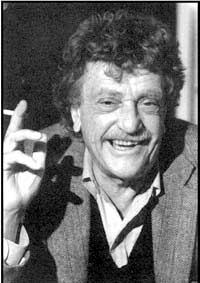
Kurt Vonnegut: A guy who knew how to make people laugh.

Recently, I have spent a lot of time thinking about the place of humor in Writing Center consultations. I think of myself as a pretty funny guy, and I try to bring that humor into my consultation sessions. It is something that I do naturally (humor was highly valued in my family), but I have also seen many other consultants laughing with writers. In fact, I would go so far as to argue that laughter is one telltale sign of a strong session.

Although my experience mainly includes Writing Center work, I believe that humor also plays an important role in instructor-student conferences as well. The best conferences I have had with professors included a lot of laughter.

Humor, when used successfully, has the ability to smooth over human interactions often fraught with anxiety. Students come into the Writing Center nervous about their work, frustrated with the assignment/class/world, scared about what their self-perceived inability to write might mean for their future careers--the list goes on. The consultant must struggle past these initial barriers in order to aid the student with her writing.

And that's where humor comes into play. Humor allows a way in for the consultant. It alleviates the fear the student might be harboring as well as alleviating the anxiety the consultant might be feeling from working with an anxious writer. This allows the consultant to figure out which of the writer's many anxieties are about her writing and which are about issues outside of her control.

When I think back on my own sessions, I see that humor serves another function. Laughing and telling jokes early in a session builds a certain amount of trust and camaraderie. It signals to the writer "We're in this together." That trust becomes very important later on in the session when the consultant begins to critique the student's writing. The camaraderie built early on, through humor, forms the basis of trust necessary for a fruitful conversation about how the student might improve her writing. Humor, fundamentally, is about trust, and trust is integral to a successful consultation.

Of course, humor sometimes goes horrifically awry. During my undergraduate days, I waited tables at the Old Spaghetti Factory. One evening, a man mentioned that he and his family were from Minneapolis. I immediately put on my best Fargo impression and said, "Oh, 'Soters, eh? Thanks for comin' down the road, there." No laughs. No smiles. Just stares colder than a Duluth winter. I felt my tip melting away; I don't think I said another word to the table.

There is a danger to using humor; the joke might go horrifically awry. However, I believe the potential benefit justifies the danger. If I were a student, walking into a Writing Center full of laughter would set my heart at ease.

I am interested in hearing about what other people think about using humor in peer-to-peer or instructor-to-student consultations. What works? What doesn't? Any good stories?

Thursday, February 6, 2014

Sports Writing for English Majors

Over the course of the semester, I have made frequent, yet subtle, attempts to encourage my fellow graduate students to share my love of sports. I provided my colleagues with a detailed synopsis of the previous day's Seahawks game each Monday morning. When FIFA announced the World Cup groupings, I took up class time to explain the announcement's importance. When college basketball started up, I taught my classmates my favorite cheer: "Go, Gonzaga! G-O-N-Z-A-G-A!" I figured English majors would like all of the spelling.

Alas, few of my colleagues have joined me in my absolute and total love of sports. While my friends quote their favorite lines from whatever movie won the Superbowl of Indie films, I watch rugby highlight clips and a video capturing Randy Johnson exploding a bird with a well-timed fastball. Although those in my cohort congratulated me for Seattle's victory over Denver, it was with the same tepid enthusiasm with which I treat the pizza coupons that arrive in my mailbox.

So, I am now attempting a new way into their hearts. I will bring sports to the people through literature. One of my favorite blogs, The Airship, recently posted a list of the best sports books of all time, and I wholeheartedly agree with their decisions--especially number five. Also, the blog Narratively put up an interesting story about the extraordinary efforts that go into a live NFL television production. And, if you do not want to do any further reading, I watched Moneyball for the first time over the weekend, and it was awesome and does not require expansive baseball knowledge for enjoyment. (If you understand the terms "ball," "player," and "money," you'll be fine. Also, Philip Seymour Hoffman, may he rest in peace, plays the coach.)

Tuesday, February 4, 2014

Beware the space invaders!

I've got more than a few grammar, usage and punctuation pet-peeves and crusades. For example: I'm anti-Oxford Comma (I see it as our patriotic duty to, as one of my professors puts it, man the barricades of American English against the British). Yes, OC proponents, I understand that serial commas add clarity. And I really do appreciate the JFK and Stalin meme. I just don't like the final comma. #SorryNotSorry.

There are other things that get my proverbial goat. It drives me bonkers, for example, that some people still maintain that we shouldn't be allowed  to wiggle around gendered pronouns by writing things like "the student took out their notebook." And I have night terrors about people who use quotation marks to add emphasis in writing. Air quotes are bad enough in conversation; do we really need to sully the wonderful world of writing with them?

Anyway, as many writing faux pas as there are to rail against, there is nothing that sets off my reading and writing rage more than double-spaces after a period. Those gaping valleys of white space after every sentence! The page just frittered away on nothingness! The waste! THE HORROR!

So, I was quite pleased when I read Farhad Manjoo's PSA about why you should never, ever use two spaces after a period. Giddy even.

Take heed, friends. Let us resist the hoard of space invaders--lest they find their way into all of our t e x t s .

Wednesday, January 29, 2014

A Question on Language


Early this month, Emily Johnson Dickerson died. She was the last monolingual speaker of the Chickasaw language. She was the last person alive whose worldview was completely Chickasaw--who could not separate the language from herself.

I didn't know Emily Johnson Dickerson. And I'm not Chickasaw. But reading about her got me to thinking. About language. About history. About power--and the lack of it. And about how all of that comes across in writing.

---

For as long as I can remember, I have been deeply interested in language and words. It might be genetic--my mom was a competitive Scrabble player, traveling across the country for meets. It might also be related to where I'm from--my hometown of New Orleans is home to a vast array of accents and dialects that have developed over almost three centuries of immigration, emigration and cultural mixing between Native American, European and African groups. Long before I'd ever heard of the Tower of Babel or Linguistic Relativity or Determinism, before Noam Chomsky blew my mind, I was interested in what it meant that I called that strip of grass in the middle of the road a neutral ground while my Georgia cousins called it a median.

When, in middle school, I started studying Latin, my interest in language was heightened. Seeing the relationship between those ancient, foreign words and my own was something magical. Later, when my English class read Sandra Cisneros' The House on Mango Street (in which the main character, Esperanza, explains that "In English my name means hope. In Spanish it means too many letters."), I started to think more about the risks, the negative consequences, how these magical codes could isolate us, limit us, keep us apart. I started to think about the linguistic changes that have occurred in my own city, my own family, my own life. Why do my parents and I speak English instead of the West African languages of our enslaved ancestors? Or the Dutch and perhaps Yiddish of the European Jewish slave traders who also contributed to our blood? Why don't I speak the French spoken by my octaroon great-grandparents?

Those are all questions for which, if I look to history, I can find satisfactory answers. I don't speak Senegambian because my ancestors who spoke it were forced to assimilate into French and Spanish speaking societies. I don't speak Dutch or Yiddish because my ancestors who spoke it didn't claim us as part of their line and, as such, didn't ever introduce us to their mother tongues. I don't speak French because, after Louisiana became a state, the Americans privileged English and coerced (read: forced) the population to learn it.

But there is a question that is, for me, more troubling. Why do I code-switch the way I do--why am I writing this blog post in this language instead of the New Orleanian African American English I use at home? I know the answer. The answer is that I learned to write in Standard American English. SAE is what I learned to use in school. SAE is part of what allows me to be inside the discourse community that I want to be inside of, to be a member of The Academy, to be part of the club. But even though I want access to the world SAE opens for me, I worry about what I'm sacrificing to be in that world.

I often joke that I'm not a creative writer--that I think it's all magic and wizardry and I respect it and value it (or maybe envy it) but I can't do it. But I think maybe the real reason is more than that. I think part of my struggle with creative writing is that, were I to write my world, it would need to be in the language I speak. But I can only write in SAE.

So, I'm wondering. Creative writers, you magical, wonderful, talented people: how much--if at all--does your language (not so much your content or style, but your actual language) change when you're switching between creative and non- (or less) creative work? Code-switchers: to what degree do you feel like you control your switching? Poly-glots: can you use your multiple languages with the same ease in all subjects? And readers: who are some of your favorite writers who write outside of standard language forms?

Tell us--or write us, as it were.


Crafted By Hand

I carry around a little black notebook in my bag and a black Pilot G-2 .07 pen in my front right pocket.  Without these items, I am a vessel adrift  in a sea of touchscreens and key boards, unable to write.

I feel almost guilty saying it, belonging as I do to the Millennial generation, but I am uncomfortable staring at blank screens. The blinking cursor in Word and Blogger is nothing short of tyrannical. Instead of an expanse of real estate awaiting my every thought, the blank page on a computer screen is an impenetrable fortress.

Fortunately, I am not alone in this preference for writing longhand. Author and video game designer James Mechner also writes in longhand, and wrote a great article on his reasons for backing away from digital devices. And, as Chris Gayomali points out in The Week, it is difficult to become sucked into a vortex of "puppy videos and ex-boyfriend/girlfriend stalking" with only a pad and pen on the desk. Writing longhand cuts down on distractions.

For me, the critical part of handwriting my ideas, outlines and first drafts is to silence my inner editor. There is an important difference between striking out a sentence with my pen and smacking that backspace button on my keyboard a few times. When I scratch a phrase out with my pen, the words are still there on the page. On a piece of paper, I see the progress I have made in articulating my ideas, even if those ideas are buried underneath black scribble marks. I build upon those lines (and lines and lines and lines) of crossed out material when formulating my ideas. With a word processor, the labor entailed in this writing, crossing out, and re-writing disappears into the ether.

Once I have a draft or a strong outline, I move to the computer. My drafts still need quite a bit of revision at this point, but when the cursor starts laughing in my face and the cold glare of the computer screen peels back the layers of my eyeballs, I refer to my handwritten draft. (If I'm still stuck, I check out puppy videos on Facebook.)

So, the next time you suddenly realize you wasted three hours reading each and every Buzzfeed list from the last three years when you were supposed to be writing your paper, shut down that laptop, find a pen and some paper, bring to mind those 3rd Grade handwriting lessons, and write. At the very least, you'll have something down on paper.
 

Key Shortcuts in Essay Writing

There are a few tools in a word processor that I use all of the time. However, many people do not know these fantastic tricks. If you already know about these tools, tell your friends and save them some time and frustration.

So, we all know about spell-check, but we don't all know about the synonym function on the word-processor. The synonym function is also extremely useful--especially for ESL students. Go to tools, thesaurus, or simply left or double-click (depending on your computer) the word you want a synonym for. That way, if you can only think of a word that is similar to the word you actually want, you can find the word you actually want.

Or, say you have a problem with tense and you want to find all of the times you used the suffix "ed" in a document. To search within your own document on your computer, go to the "Edit bar. Under "Edit" click "find", or "go to", or "replace", depending on what you want to do.

If you are looking for something specific within a research journal, rather than reading the entire thing and finding no mention of whatever it is you are searching, search within an online document by pressing Command F. Try it now, and a search bar will appear on your screen. Now search "sun." Look, the sun is highlighted!

To highlight multiple things at once hold down Command while you highlight. This is useful for editing long documents.

http://awespendo.us/animemangacomics/keyboard-shortcuts/