Showing posts with label Citation Systems. Show all posts

Tuesday, October 11, 2016

Why I Love the New MLA and Why You Should Too

I’m not exaggerating when I say I love the new MLA. You may be thinking, Is it really possible to be that excited about citation guidelines? Let me be the first to tell you: It is! Thanks to the new MLA, you’ll no longer dread creating that Works Cited page. You know, the page that you spend just as much time on as your actual paper? Now, instead of spending precious writing time on a reference page that is probably full of mistakes anyway, you can take that extra hour to put the finishing touches on your paper. Creating a flawless Works Cited page will take you no time at all!  

Here are just a few ways in which the new MLA is making your life easier:

  1. It uses simple punctuation.

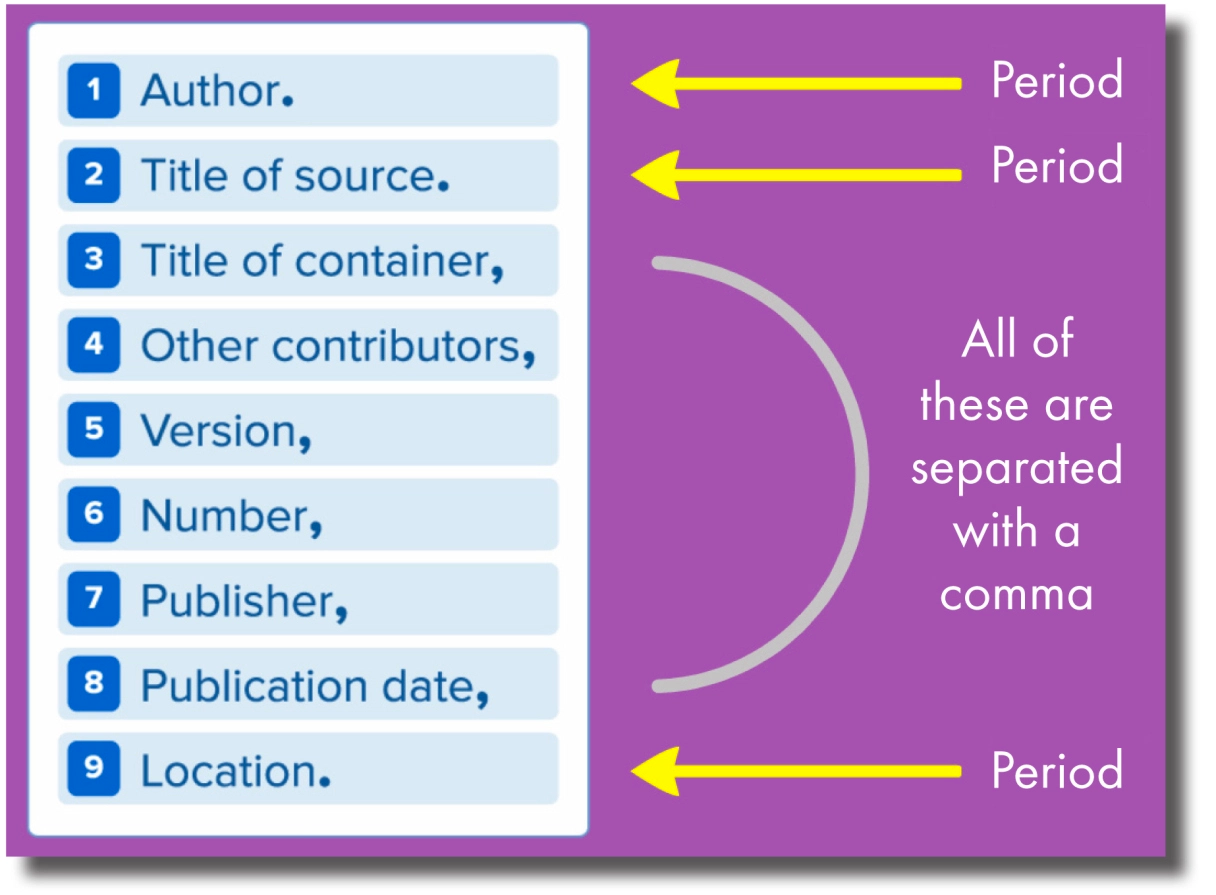
This change may be my favorite part about the new MLA. No more colons, no more parenthesis, and no more periods in weird places. The new MLA only requires the use of two types of punctuation, the period and the comma. Place a period after the name of the author and the title of your source, and separate the rest of the core elements with commas. Then, end your entry with a period. How easy is that?!

  1. All sources are cited using the same basic format.

The old MLA required you to identify the type of source you were citing. Is this a periodical? Or maybe it’s a peer-reviewed journal? Do I even know what a peer-reviewed journal is? I think it’s just an article. Wait, is this a blog? This thought process might sound familiar. Depending on the type of source you used, there was a specific set of guidelines for your works cited entry. If your source fit into two of those categories (like a book on an online database), it became even more complicated. Now, all you need to know are these nine core elements (also listed above). Identify as many of these nine elements as you can for each of your sources, and you’re already on your way to creating a successful Works Cited page!

  1. It’s reader-friendly.

Unless you’re an expert on MLA, you probably had no idea what most of the numbers in a Works Cited entry referred to. I mean 20.2 (2013): 120-130 doesn’t really tell us much. Luckily for us, the Modern Language Association realized this too and decided to make these numbers more reader-friendly. Now, if a journal has a volume or an issue number, you can use abbreviations to identify them. There are also abbreviations for edition and page numbers, which your readers will easily recognize. Here’s an example:

Baron, Naomi S. “Redefining Reading: The Impact of Digital Communication
Media.” PMLA, vol. 128, no. 1, Jan. 2013, pp. 193.

In this entry, it’s clear what the volume (vol.), issue number (no,), and page numbers (pp.) are. Even better, the abbreviations are sensible and easy to remember!

  1. Only the most relevant information is needed.

“I hate when I look at a Works Cited entry only to be devastated when the city of publication is missing,”….said no one ever. While there are special circumstances where you might record the city of publication (a version of the same work is published in two countries), this piece of information is normally excluded now; and let’s be real, we’re pretty glad it is. Also, you no longer need to identify whether the source is “print” or “web.” Identifying the page number(s) or URL (location) in your entry is enough to let your reader know if it is a print or web-based source.

  1. You can actually remember these rules!

I used the old MLA for seven years, and there were very few times I created a Works Cited page without having to look up the correct guidelines. I’ve been using the new MLA for about three months now, and I can already cite my sources on my own with confidence. Now, don’t get me wrong; I still flip through my MLA Handbook, 8th Edition every now and then or check out Purdue OWL’s amazing website when I come across a new citation question. For the most part, however, it’s pretty easy to remember MLA’s new guidelines, and that makes my life a heck of a lot easier!

Good riddance, old MLA!


Friday, April 5, 2013

Back to Gula

Using Robert J. Gula's Nonsense Red Herrings, Straw Men and Sacred Cows: How We Abuse Logic in Our Everyday Language as my guide, I've spent much of this semester blogging about fallacies. Occasionally, I've deviated from this topic, but for my final posts of the semester, I've decided to return to it. 

Of all the fallacies that you will encounter in college, none of them seems as obviously immoral as the ones associated with quotation. Gula identifies two such fallacies. For the sake of simplicity, I'll refer to these as the Fallacy of Quoting out of Context and the Fallacy of Selective Quoting.

In this post, I will address the Fallacy of Quoting out of Context. In my next post, I will focus on the latter. 

When you take a first-year composition course, you learn about the importance of proper citation. You learn the difference between a quotation and a paraphrase. You learn about the severe academic consequences of plagiarism. 

But aside from the academic consequences associated with using another person's words or ideas without including an adequate citation, are the moral consequences of using another person's words in a deceptive fashion, all the while still following the protocols of an acceptable citation system.  

I'm sure most of us would readily agree with Gula when he writes, "Quoting out of context can turn a person's words against him" (92). 

The indignation you feel is particularly intense when something you said or wrote is taken out of context in order to convey an attitude or behavior that you neither expressed or performed, is it not? Sometimes, if what you said or wrote is quoted out of context, it can be misrepresented to such an extent that it conveys a meaning which is opposite the meaning you actually articulated. To illustrate this fallacious tactic, let's look at the following example. 

Suppose you overhear a roommate whom you don't particular care for say the following sentences. 
"Let's steal the final exam. All we have to do is get the flash drive she keeps it on. She'll never know."

Sounds fairly incriminating, does it not? 

If his words are quoted verbatim, then it seems like the roommate is conspiring to commit academic fraud.  If a professor or an administrator were to ask you whether your roommate ever planned on committing academic fraud, you could think back to these sentences and say: "Yeah, I heard him discussing it with my own ears. One morning I heard him say, 'Let's steal the final exam. All we have to do is get the flash drive she keeps it on. She'll never know.'"  

But suppose you also know that your roommate is an aspiring dramatist who writes and rehearses his plays in your living room. Suppose further that you also know the plot synopsis of his most recent play: a group of students plan to steal a final exam and tragedy ensues. 

You've heard of the colloquialism that distinguishes between the letter of the law and the spirit of the law? 

Well, here we have a situation where a conflict arises between the letter of meaning and the spirit of meaning. According to the letter of meaning, your roommate intends to commit academic fraud. According to spirit of meaning, your roommate intends to develop an interesting dramatic plot. To interpret correctly the meaning of his words requires the appropriate context. To ignore or suppress this context would distort your roommate's meaning in a rhetorically significant situation--the situation being the hearing on whether your roommate ever plotted to commit academic fraud. 

To quote someone out of context is not an act of plagiarism; it is, however, a fallacy, thus it should be avoided.     

Wednesday, September 19, 2012

Citations - Parking, APA, MLA, & the Purdue OWL


Citations, citations, citations.

Most of us hate them. Whether they come in the form of parking tickets (of which I received two…in two different cities in a matter of two days) or in the form of a reference list, they are ever the cherry on top of a bad day sundae. (Sense the sarcasm.)

Citing sources is not hard. However, when we're juggling a million different thoughts and tasks and our attention is otherwise occupied, it makes getting them done correctly hard.

MLA or APA? Italics or quotation marks? Underline or parentheses? Citing is a never ending balancing act of the memory. There are no easy ways to remember which rules apply to which style. There are no pneumonic devices, at least that I know of, to jog the memory.

So … how do we get it right? Instead of taking an “educated” guess (we learned them both at some point, right? So we have a 50/50 shot of getting it correct.), why not seek the exact formula we need?

Easier said than done, right?

Wrong.

There is a handy-dandy website called Purdue Online Writing Lab or Purdue OWL for short that makes the entire process of citing – for lack of a better term – idiot proof. I use it weekly.

There are examples for every different kind of source. They show exactly where the author’s name, the title of the source, page numbers, publisher’s name, etc. all go. Essentially, there is no way to go wrong when using this website. We just transfer the information from our source into the “blanks” of the example and voilá! We are done citing.

The moral of this story: when in doubt, put some change in that meter or go to Purdue OWL’s website to double-check how to do in-text citations and bibliographies.

For specific links to guides for APA or MLA, here are you go-to sites:
In addition, you can find both of these links -- and more -- on the "Resources for Writers" page of the EIU Writing Center's webpage. 

Tuesday, April 24, 2012

JSTOR and More

It's still the week before finals, so I figure every little bit helps. The assignment that many of us have due within the next couple weeks is no doubt a research paper. Sure, it's a pain to seek sources (who has time for that?), but I figure I'll try to make it slightly less painless by helping you to find sources with relative ease.


EIU students (and I imagine students at most universities) have access to the wonderful database, JSTOR. For someone like me, JSTOR is a dream come true. Type in what you're looking for and JSTOR will come up with related results much like your average search engine. However, unlike your average search engine, your results are not webpages but scanned and digitized versions of articles from various academic journals. Does your instructor demand peer-reviewed scholarly articles? Look no further. Actually, scratch that. Do look further but further into JSTOR.


Let's say I want to find something about Walt Whitman. In the search field, I'll type "walt whitman" (capitalization be damned in the search bar!). JSTOR promptly brings up results 1-25 of 16012 for "walt whitman." Now let's say my paper's on Walt Whitman and Abraham Lincoln. There are two ways I can search for articles about the both of them. One way involves simply typing "walt whitman and lincoln." The other way is typing "walt whitman" into the first search bar, and then "lincoln" into the one right below it. There's a drop-down menu right next to it that'll say "AND." It's other options are "OR," "NOT," "NEAR 5," "NEAR 10," and "NEAR 25." This drop-down menu can be useful in that if I wanted to, I could leave out results with "lincoln" by putting it into the second search bar and selecting "NOT." This can be helpful in omitting unwanted information in your later search.


Now enough about searching. Let's look at an article we found. We'll take a look at "Walt Whitman and Lincoln" by Clarence A. Brown, the fifth result of searching for "walt whitman and lincoln." There's a small box just above the first page of the article that has a few different options. One is, "View PDF" which you can use to download the PDF version of the scanned article for later viewing at your leisure. The rest of them, however, all involve citations. The most useful option may be "View Citation." It should be noted that the citation that they give you isn't in a format that I recognize so it may not be a commonly-used citation system:
Walt Whitman and Lincoln
Clarence A. Brown
Journal of the Illinois State Historical Society (1908-1984) , Vol. 47, No. 2 (Summer, 1954), pp. 176-184
Nevertheless, it gives you all the information you'll need.


Also, if you're in a pinch, some articles have a summary or abstract that you can read. "Walt Whitman and Lincoln" does not, but if you want to find it on an article that you've found on JSTOR, select "Summary" next to "Page Scan" just above the article's image. Aside from an abstract, it will also list all of the footnotes and bibliographic information you'll need.


EBSCO is another invaluable resource with a bit more variety. Often, people will use the Academic Search Complete, which touts itself as "the world's most valuable and comprehensive scholarly, multi-disciplinary full-text database." Regardless of which part of the EBSCO database you use, they'll all have the same interface. Using the MLA International Bibliography, we'll do a similar search as earlier about "walt whitman." Similarly to JSTOR, we have a drop-down menu with options like "AND," "OR," and "NOT." But for now, we'll just stick with a "walt whitman" search.


There is some overlap with articles, but there are also some new results here. We'll look at Jim Garrison's "Walt Whitman, John Dewey, and Primordial Artistic Communication." You'll notice we don't get a scanned copy of the essay right away; instead we get a bunch of information. From here, you can formulate a citation. That being said, there's also an option on the side called "Cite" that will give you citation examples for that particular work in some of the more common citation formats. It is a convenience that JSTOR doesn't provide. 


Not all articles have a PDF copy on EBSCO, but they will almost always have some way for you to find it. Sometimes it might link to another database like Project Muse, or will send you back to your library's website to search for the location of the article on your shelves. Nevertheless, it's an important tool to legitimate research. 


Aside from all of that, all that's left is to curl up next to the fire with a good scholarly journal article.

Tuesday, April 17, 2012

Down to the Wire

All right, folks. Eight days left of classes and a week of finals.

For some of us, finals means cramming for examinations and avoiding sleep like you're in A Nightmare on Elm Street. For the lucky rest of us, that means just papers, big ol' eight-to-ten page monsters with two pages of sources listed adhering to the strict rules of MLA or APA citation. We crawl to the ends of the paper, unsure if our professors want eight full pages or seven pages with two lines on that eighth page.

Sound familiar?

Because it's getting to be that DOWN TO THE WIRE time, the smell of procrastination will be thick in the air. Thankfully, most people (including myself) will be procrastinating as well, so we'll get used to the smell.

Aromas aside, because time will be a scant resource, certain aspects of the writing process may be neglected, namely revision and proofreading. I'm guilty of it myself, but when I luck out (i.e. when I work on things early) and have time to revise, I feel better for it. Not only that, but so also feel my grades.

But "revision" can be seen as this nebulous term that isn't quite clear to students. Does it mean checking for grammar? Does it mean rewriting the sucker? Here at EIU, we've got a handy handout that might assist in clearing up just what we talk about when we talk about that final stretch of the writing process.

Basically, we're talking about two things: "deep revision" and "editing/proofreading." The latter is where we go through and clean up those grammatical issues like tense shifts and spelling errors.

The former, on the other hand, is where we dig deeply into what larger concerns might lie beneath the surface of your paper. I like to think of it like we're trying search for problems under the surface, so something like this doesn't happen:


Sinkholez


As perfect as your paper might feel by the end of it, it's important to make sure you don't have any structural problems beneath. Let's focus on that for a bit with a few questions to ask yourself:
  1. What's your big picture? What's your point?
  2. Do you yourself pose any questions that you maybe didn't consider as you wrote it?
  3. If someone else reads this, can they tell you your main points back to you?
  4. What does each paragraph do in your paper?
You'll want to read your paper slowly and likely more than once if you want to fully grasp what these questions will help you figure out. If you don't do any of this, there is that possibility that you might've been okay.

But sometimes it's a crapshoot--you just might've built your paper on a structure that'll give you this later:

Moar Sinkholez

Thursday, April 5, 2012

OWL-ternative Online Sources: The Smackdown

In the spirit of March Madness, we here at EIU Writes will be examining the other online writing labs that we've discovered so far and pit them against one another until only one brave gladiator remains.  Sure, there are a bunch of alternatives ... so what?  How do they stack against one another?  Do any of them give the Purdue OWL a serious run for its money?  Well, brave home viewers, lets put on our game pants and find out.  (We're also apparently at a loss of synonyms for "smackdown" ... or we really like that one.)

So, without further ado, let's take a look at our contestants (spectators, fighters, racers ... take your pick) for the evening.  I'm joined tonight by Fake Doug, since the real Doug can't be here to help me spectate.  Too bad for him.  Anyway, let's hear it for our OWL-ternatives:

HyperGrammar: Hailing from the University of Ottawa, HyperGrammar boasts the British spelling of Centre, a virtual classroom, and a plethora of links embedded within the texts, explanations, and examples.  It's sleek user interface and professional appearance certainly give it a level of aesthetic appeal.

Steve: Do you think our Canadian underdog stands a chance tonight, Fake Doug?
Fake Doug: H.G. is certainly a strong contender, even if it has nothing to do with anyone named "Adrian."  Parts of it are still under construction, but enough of it is finished to make the overall site rather smashing.
Steve: The real Doug would never say "smashing."
Fake Doug: He would to spite you for saying that.
Steve: Fair enough.  Anyway, on to the next combatant ...

Guide to Grammar and Writing: Also known as the "The Super Duper Zany Grammar Funhouse of Doom" (at least in my book), this lab is based out of the Capital Community College Foundation of Hartford, Connecticut.  Though its visual appeal is childish and clumsy, its vast index of grammatical terms and explanations make it a useful tool for any writer, budding or veteran.

Fake Doug: You should stick with its original name.  Yours is terrible.
Steve: But what's not terrible is G.G.W.'s index.  If anything gives it weight in this competition, that's going to be it.
Fake Doug: S.D.Z.G.F.D -- that's what your acronym would be.  Terrible.
Steve: Shush, you.  Next!

The Writer's Handbook: From the University of Wisconsin at Madison, The Writer's Handbook isn't quite as beefy as the Purdue OWL, but it does have a clear breakdown of several topics that many writers can find immediately relevant.  It gives specific tips on research paper, dissertations, proposals, and other forms of academic writing that often throw students for a loop.  The interface is simple, straightforward, and pretty easy to use.

Steve: The tiny text on the right-hand bar can give you a headache if your vision sucks like mine.
Fake Doug: To be fair, Purdue's OWL isn't retina-friendly, either.  The big cheese's influence is pretty apparent in the layout.  Not necessarily a bad thing, though.
Steve: Retina-friendly?  Really?
Fake Doug: Don't get snarky with me.  I'm not the one writing those lines.  Just introduce the last one, will ya?

Writing@CSU: Last, but certainly not least, Colorado State University's website packs some serious punch with resources ranging from small articles, to textbooks, to online word processors to help organize ideas.  It has resources for teachers and students alike, and the layout isn't painful to look at.

Fake Doug: If this website were a person, I'd marry her.
Steve: It is definitely aesthetically pleasing, but it's not just a pretty face, you know?  Lots of good stuff here.  You seem pretty into this competitor, Fake Doug.  Any reason why?
Fake Doug: Partially because you're exaggerating my enthusiasm.
Steve: That's a shame.
Fake Doug: Even so, it's still an awesome site.  It probably has the most variety out of all the OWL's we've looked at so far.  Even -- dare I say it -- Purdue's.  The resources are good, and the different kinds of resources are staggering.
Steve: Definitely.  We'll see if that gives it the edge it needs.

And with each of our competitors out and ready to roll, it's time to rumble!  Let's see how these OWLs compare.

Round 1:
HyperGrammar ~vs~ The Writer's Handbook

Even though HyperGrammar still has parts undergoing construction, it manages to beat out The Writer's Handbook according to us here on EIU Writes.  HyperGrammar isn't trying to be the OWL, and that gives it a lot of clout.  Sure, there are many OWL-esque features that it shares with The Writers Handbook and Purdue, but it's easier to navigate than its opponent (especially considering those nifty embedded hyperlinks) and plenty informative.  Though both are solid sources, we give the victory to HyperGrammar!

Round 2:
Guide to Grammar and Writing ~vs~ Writing@CSU

Guide to Grammar and Writing, while informative, gets the snot kicked out of it by Colorado State's spiffy interface.  Though one could argue GGW's buckets of raw information outweigh the information found on WCSU, the manner in which the information is presented does matter.  WCSU makes it absolutely clear where you need to go to find specific, relevant information rather than giving you a whole bunch of drop-down menus to choose from.  GGW definitely has a lot of heart, but WCSU certainly isn't lacking for substance either.  Colorado State takes the victory in this one.

Semi-Finals:
HyperGrammar ~vs~ Writing@CSU

A close match, for sure.  Once again, WCSU's sleek, objective-driven interface gives it the edge it needs to pull away from its Canadian opponent.  Though we still recommend HyperGrammer for those looking for specific rules and definitions, WCSU weighs in as a better overall resource for writing.  The Semi-Finals go to Writing@CSU.  Insert obnoxious applause and cheering here.

Finals:
Writing@CSU ~vs~Purdue OWL

After a near-eternity of blood, sweat, and tears, both of our brave competitors come out scratched and bruised -- but not beaten.  Crazy though it may seem, this final match-up ends ... in a draw.  I know, I know!  Yes, ties are lame!  But honestly, both of these writing labs offer equally good resources depending on what you're looking for.  The victory is purely contextual.  If you're looking for information on a given citation style, Purdue is the big dog.  It blows WCSU out of the water.  It has examples galore -- we all know that.  However, WCSU's variety of peripheral writing tools, such as the built-in bibliography tracker, outlining tool, and in-site word processor (just to name a few) make it a completely unique OWL experience. 

So, for those looking for a more specific verdict:  The Purdue OWL is better for the sake of pure information.  The examples and clarity are second-to-none.  However, if you're looking for a more interactive, hands-on OWL experience that integrates information with various tools and external resources, then WCSU might actually be the better choice.

The moral of the story is you can bring a horse to water, but you can't judge it by its cover.

No, wait, that's not right.  Ah well ... I'm sure it will come to me eventually.  In the meantime, keep on writing, and don't be afraid to expand your horizons!  There are plenty of good resources out there, just waiting to be stumbled into.

Monday, March 19, 2012

Citation Smackdown: MLA versus APA

There seems to be some disagreement among the disciplines as to what citation style is superior: MLA versus APA. Some of the spineless "pacifists" who wish to remain outside of the argument simply state that they serve their own purposes, like MLA for literary analysis and APA for scientific research. I say "nay" to that. An emphatic "nay!" While it's true that they do serve certain disciplines more easily than others, ultimately there has to be one that reigns supreme over the other. MLA and APA can't share kingship (or queenship).

You might be saying, "They both do in-text citations and bibliographies, so why does it matter?" Just because they both do it, doesn't mean they do it clearly or concisely. Others of you might be saying, "Well, I use Chicago style." Well, get out. This isn't meant for you.

First, let's look at MLA. It's sleek, it's simple. You don't get bogged down by the information. Check it:
According to Whitmore, the book "took liberties with the life of Bruce Campbell" (93).
The citation is non-intrusive. Here all we have is a page number in parentheses after the author is already mentioned. Any further information can be found on that back page called "Work Cited." But how does APA do it?
According to Whitmore (1997), the book "took liberties with the life of Bruce Campbell" (p. 93).
Ugly. Grotesque. More numbers than there ought to be. And the "p." before the page number? Is that necessary? I think not. While in some cases it might be convenient for the reader to find the cited work's year of publication in the sentence their reading, the parenthetical year can kill the rhythm of a work. Yeah, the reader's not necessarily supposed to read the year, but they still do it in their heads. I do it in my head. I'm still doing it in my head. 1997. Argh.

Parenthetical citation-wise, I think MLA has the upperhand. But then again, I'm just talking about a fake article written about a fake book about Bruce Campbell. What if I had online sources dealing with the same issue?

If it's MLA, I sure hope it's a Tweet.

I kid. According to the Purdue OWL, there are a few online sources that you can clearly cite utilizing MLA format. Its scope, however, is a bit limited. APA, on the other hand, blows MLA out of the water by having specific citation styles for wikis, audio and video podcasts, computer software, online interviews, etc. Sure, APA doesn't outright tell you the proper way to cite a Tweet on Twitter, but by golly it'll tell you how to do so for an "interactive map," whatever that might be.

While I do have particular affection for MLA, compared to APA it does seem a bit behind in the times as far as the intarwebz goes. Maybe in the 8th edition of the MLA manual it'll step it up and tell me how to cite my Facebook statuses.

They deserve it.

Monday, February 20, 2012

Citation Spotlight: Turabian Nights

Working in the Writing Center, I don't see much variation in citation styles that students bring in. Usually, a student needs help with either APA or MLA. I've had the occasional student that wants to work on Chicago, and I've even seen citation styles that I can't even remember the names of. The one I haven't seen yet, however, is Turabian.

Named after Kate L. Turabian, the late graduate school dissertation secretary of University of Chicago, the style nowadays is "essentially the same as those presented in The Chicago Manual of Style, 15th edition, with slight modifications for the needs of student writers" (Turabian). Sounds nice, no?

Upon first inspection, I could see several similarities between Turabian and MLA and APA, and for good reason. Turabian is divided into two sub-styles: notes-bibliography style for the literature and history kids, and parenthetical citations-reference list style for the science folk. Take a look at this example on the official online Turabian Citation Guide:
One author
Note: 1. Wendy Doniger, Splitting the Difference (Chicago: University of Chicago Press, 1999), 65.
Bibliographic: Doniger, Wendy. Splitting the Difference. Chicago: University of Chicago Press, 1999.
Parenthetical: (Doniger 1999, 65)
Reference: Doniger, Wendy. 1999. Splitting the difference. Chicago: University of Chicago Press.
The parenthetical in particular reminds me of the MLA and APA style both in that it includes a year following the author's name, but it doesn't have a "p." before the page number to denote that it is the page number. APA style is seen in the reference in terms of the method in which the title of the work is capitalized.

Turabian is a curious style in that it covers nearly the entire spectrum of academic research. Your safest bet is to always go with the style your instructor suggests or requires, but should you find yourself in a class with a bit more leniency given to your chosen citation style, I suggest giving Turabian a try. Regardless of where you're coming from academically, you'll find that the transition to Turabian should be relatively painless.

Thursday, November 17, 2011

Word Monster

Why is that word wrong? I didn’t write that? The problem is figuring out what happened.

Ahahahahahahahah.

It’s the Word Monster! Or better known as the dreaded spell check trap.

Because of this Word Monster, proofreading your own paper is even more important. Spell check is helpful, but those squiggly lines that appear under your words or citations don’t necessarily mean they are wrong.

Proofreading is an important part of the writing process because if wrong words appear in sentences, then they can alter the entire meaning of those sentences.

Examples of the Word Monster within your paper can be:
Define and definite
Obtain and abstain
Weather and whether
Affect vs. effect
Corpse vs. corps
Text anxiety vs. test anxiety
Immunity vs. impunity
Test vs. testes
They’re vs. there vs. their

Along with word changes, sometimes Microsoft Word has weird squiggly lines underneath citations. An example would be a citation I turned in for a paper recently: 
Baker, Timothy C. “The (Neuro)- Aesthetics of Caricature: Representations of Reality in Bret Easton Ellis’s Lunar Park.” Poetics Today. Fall 2009. MLA International Biography. Web. 1 September 2011.
Though the citation is right, the Word Monster underlines parts of my citation as if they were wrong, and they are not.

Because of the Word Monster's antics, proofreading is even more important than it was when we had no other option than writing papers by hand and then typing them. 

So watch out for the Word Monster! Proofread your papers before you turn them in and make sure your words are your words, not the Monster’s!

Monday, October 10, 2011

Citation Spotlight: CBE Style

In my experience, the two major players in the world of citation styles have always been those of the Modern Language Association (MLA) and the American Psychological Association (APA). With my background as an English major, MLA is what you could call "my jam"; it's the style I'm most comfortable with and it makes a far more sense than that rage-inducer APA. But APA is far more widely used than MLA, as MLA is used solely in the field of English and literary studies, unlike APA which is used in basically everything else.

There are other styles, of course. You have Chicago and Turabian, two styles that if you showed me examples of the two I would have no clue which was which. And then there's the Council of Biology Editors (CBE) citation style, which up until the last couple months I had no idea existed.

Ten points to the person who guesses what disciplines it's used for.

Being the inquisitive type, I looked into this mysterious citation style. I began my search on the Purdue OWL website, but I found my search fruitless; the OWL focuses primarily on MLA and APA, the two most commonly used citation styles in the United States.

A Google search, however, yielded far more results. Google compiled 1.6 million results (in an astonishing .17 seconds!) for "cbe citation style," the first ten of which all were websites containing the ".edu" domain suffix. What does that mean? Well, for starters, it means it's legit--".edu" screams credibility.

Further research into CBE showed similarities between CBE and APA, not terribly surprising considering the pervasiveness of APA among science writers. An example provided by the Frederick Douglass Library at University of Maryland Eastern Shore gives the example for citing a book by a single author:

Li TSC. 2000. Medicinal plants: culture, utilization and

phytopharmacology. Lancaster (PA): Technomic. 517p.


Those familiar with APA will notice that certain APA conventions are followed. For example, the title of the book is listed in a similar manner as APA as only the first word of the title has its first letter capitalized. Additionally, first names are initialed as opposed to MLA, which requires the full name of the author. Structurally, the two styles follow the same order of author-to-year-to-title, sharing an emphasis on dates in which the works are published.

Curiously, however, CBE diverges from APA in that it abandons the punctuation following the author's last name, as well as after each initial of her first name. Also, CBE places an importance on where the book was published.

Citation styles continue to evolve and separate like single-cell organisms. Though you may have memorized a particular style a couple of years ago, the moment a new edition comes out all you knew may be torn asunder. Keeping updated with stylebooks can get to be expensive, however, so the most ideal way to keep in touch with the latest changes in your favorite citation style is to pay attention to Purdue's OWL or do a simple Google search.

Further reading and citations:

"How to Cite Using CBE" from the University of Maryland - Eastern Shore

"CBE Citation Style" from the University of Maine at Farmington

"Council of Biology Editors Citation Style" from the University of Wisconsin - Madison