Showing posts with label MLA Style. Show all posts

Tuesday, October 11, 2016

Why I Love the New MLA and Why You Should Too

I’m not exaggerating when I say I love the new MLA. You may be thinking, Is it really possible to be that excited about citation guidelines? Let me be the first to tell you: It is! Thanks to the new MLA, you’ll no longer dread creating that Works Cited page. You know, the page that you spend just as much time on as your actual paper? Now, instead of spending precious writing time on a reference page that is probably full of mistakes anyway, you can take that extra hour to put the finishing touches on your paper. Creating a flawless Works Cited page will take you no time at all!  

Here are just a few ways in which the new MLA is making your life easier:

  1. It uses simple punctuation.

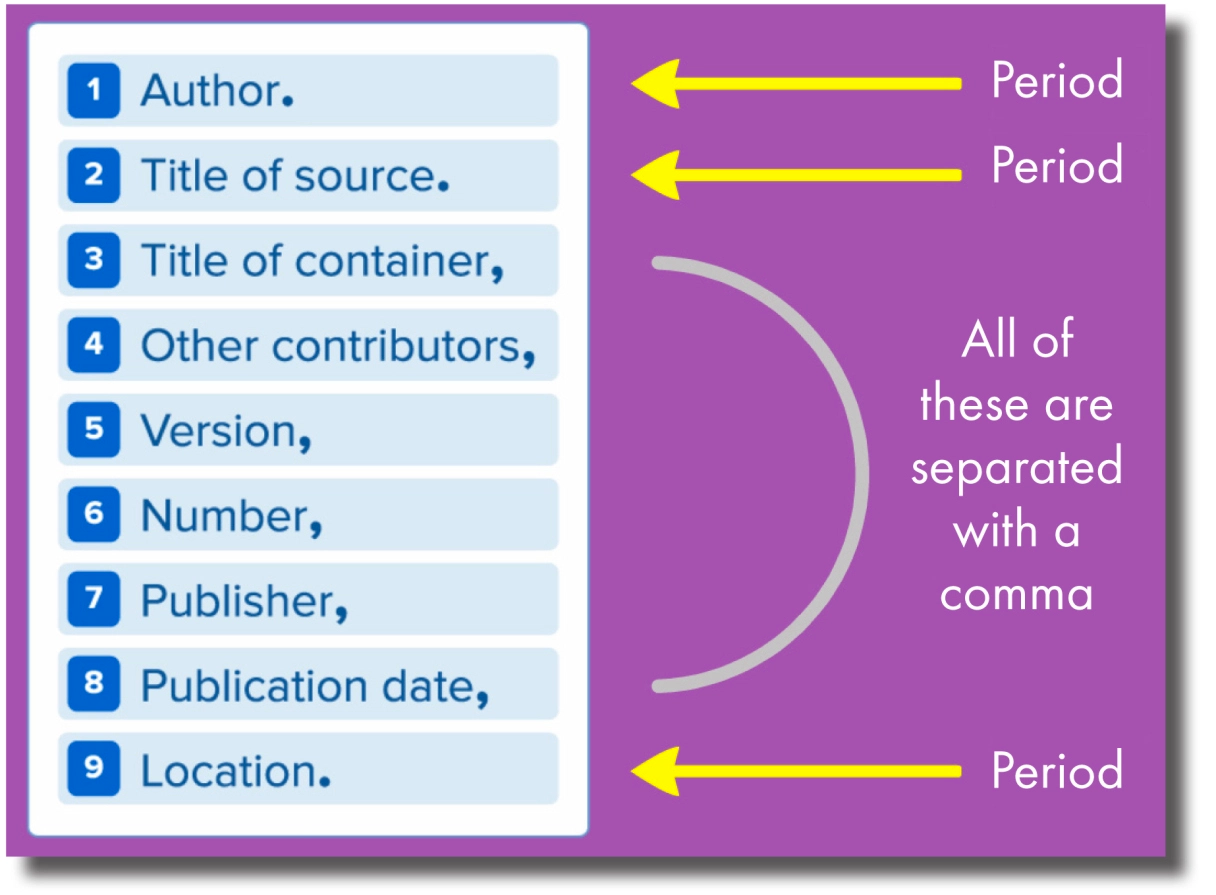
This change may be my favorite part about the new MLA. No more colons, no more parenthesis, and no more periods in weird places. The new MLA only requires the use of two types of punctuation, the period and the comma. Place a period after the name of the author and the title of your source, and separate the rest of the core elements with commas. Then, end your entry with a period. How easy is that?!

  1. All sources are cited using the same basic format.

The old MLA required you to identify the type of source you were citing. Is this a periodical? Or maybe it’s a peer-reviewed journal? Do I even know what a peer-reviewed journal is? I think it’s just an article. Wait, is this a blog? This thought process might sound familiar. Depending on the type of source you used, there was a specific set of guidelines for your works cited entry. If your source fit into two of those categories (like a book on an online database), it became even more complicated. Now, all you need to know are these nine core elements (also listed above). Identify as many of these nine elements as you can for each of your sources, and you’re already on your way to creating a successful Works Cited page!

  1. It’s reader-friendly.

Unless you’re an expert on MLA, you probably had no idea what most of the numbers in a Works Cited entry referred to. I mean 20.2 (2013): 120-130 doesn’t really tell us much. Luckily for us, the Modern Language Association realized this too and decided to make these numbers more reader-friendly. Now, if a journal has a volume or an issue number, you can use abbreviations to identify them. There are also abbreviations for edition and page numbers, which your readers will easily recognize. Here’s an example:

Baron, Naomi S. “Redefining Reading: The Impact of Digital Communication
Media.” PMLA, vol. 128, no. 1, Jan. 2013, pp. 193.

In this entry, it’s clear what the volume (vol.), issue number (no,), and page numbers (pp.) are. Even better, the abbreviations are sensible and easy to remember!

  1. Only the most relevant information is needed.

“I hate when I look at a Works Cited entry only to be devastated when the city of publication is missing,”….said no one ever. While there are special circumstances where you might record the city of publication (a version of the same work is published in two countries), this piece of information is normally excluded now; and let’s be real, we’re pretty glad it is. Also, you no longer need to identify whether the source is “print” or “web.” Identifying the page number(s) or URL (location) in your entry is enough to let your reader know if it is a print or web-based source.

  1. You can actually remember these rules!

I used the old MLA for seven years, and there were very few times I created a Works Cited page without having to look up the correct guidelines. I’ve been using the new MLA for about three months now, and I can already cite my sources on my own with confidence. Now, don’t get me wrong; I still flip through my MLA Handbook, 8th Edition every now and then or check out Purdue OWL’s amazing website when I come across a new citation question. For the most part, however, it’s pretty easy to remember MLA’s new guidelines, and that makes my life a heck of a lot easier!

Good riddance, old MLA!


Wednesday, September 19, 2012

Citations - Parking, APA, MLA, & the Purdue OWL


Citations, citations, citations.

Most of us hate them. Whether they come in the form of parking tickets (of which I received two…in two different cities in a matter of two days) or in the form of a reference list, they are ever the cherry on top of a bad day sundae. (Sense the sarcasm.)

Citing sources is not hard. However, when we're juggling a million different thoughts and tasks and our attention is otherwise occupied, it makes getting them done correctly hard.

MLA or APA? Italics or quotation marks? Underline or parentheses? Citing is a never ending balancing act of the memory. There are no easy ways to remember which rules apply to which style. There are no pneumonic devices, at least that I know of, to jog the memory.

So … how do we get it right? Instead of taking an “educated” guess (we learned them both at some point, right? So we have a 50/50 shot of getting it correct.), why not seek the exact formula we need?

Easier said than done, right?

Wrong.

There is a handy-dandy website called Purdue Online Writing Lab or Purdue OWL for short that makes the entire process of citing – for lack of a better term – idiot proof. I use it weekly.

There are examples for every different kind of source. They show exactly where the author’s name, the title of the source, page numbers, publisher’s name, etc. all go. Essentially, there is no way to go wrong when using this website. We just transfer the information from our source into the “blanks” of the example and voilá! We are done citing.

The moral of this story: when in doubt, put some change in that meter or go to Purdue OWL’s website to double-check how to do in-text citations and bibliographies.

For specific links to guides for APA or MLA, here are you go-to sites:
In addition, you can find both of these links -- and more -- on the "Resources for Writers" page of the EIU Writing Center's webpage. 

Monday, April 2, 2012

OWL-ternative Online Sources, Part 4

And so we come to part four of our brief series on alternative Online Writing Labs. I hope you've had a hoot [strained laughter] reading our examinations of various OWLs. Today, I will examine Colorado State University's "Writing@CSU," a site I'm convinced is going above and beyond the call of OWL duty in what it offers to students.

Aesthetically speaking, the front page is a welcome sight. The menus have forest green backgrounds that compliment the Rocky Mountain vistas that comprise the banner at the top of the page. The font is a friendly sans-serif that lures in the writer without making him or her think this will be some dry instructional website.

Instructionally speaking, CSU's OWL offers up guidance on "Preparing to Write," "Starting to Write," and other aspects of the writing process. These articles are divided into further subcategories relating to "reading and writing as social acts" as well as attention to audience. For those who want to step it up from website guides to full-fledged textbooks, Writing@CSU offers "open-access textbooks" which are freely available to both students and teachers, regardless if you attend CSU or not.

What caught my eye most about Writing@CSU is their "Writing Tools" section in which they offer a built-in word processor as well as an Outliner tool "to organize your ideas for a draft" or Bibliography tool to "keep track of your sources." While most students have access to Microsoft Word at home or in a library, this might provide a nice alternative to traveling with a flash drive. Unfortunately, all of these requires an account to access. Despite this restriction, you're not required to be a student to use them.

Writing@CSU does a lot more than I've yet to see in an OWL, but it's not completely perfect. Navigating its articles can be more of a hassle as its Writing Guides are split into subtopics and further subtopics. That being said, I still think other OWLs could take a page from CSU's book and offer organizational tools that will help students put together solid papers.

Monday, March 26, 2012

OWL-ternative Online Sources, Part 3

I'm going to hop onto Stephen's bandwagon and ride shotgun if he doesn't mind (do you?) to offer up an OWL-ternative (darn fine pun) website myself. After perusing a few online writing labs from various universities, I stumbled across University of Wisconsin at Madison's "Writer's Handbook." It doesn't match the thoroughness of Purdue University's OWL, unsurprising considering Purdue launched theirs in 1994 when the Internet was but a wee tyke. Nevertheless, it's a solid alternative that is easy to navigate and less overwhelming than its Purdue counterpart.

The main index is simple yet elegant; on the left side of the page is a purple (or green for all I know since I'm colorblind) area with links for such topics as "Improving Your Writing Style," "Stages of the Writing Process," "Common Writing Assignments," and "Grammar and Punctuation." All of these proceed onto further pages of links offering advice in sentence concision and comma usage, most of which offer solid examples.

What I found unique about UW-M's OWL is that one of the pages offers a "self-test and answers" link that allow you to "test your knowledge" of a given subject. Want to see how up to snuff you are at commas? Scroll to the bottom of the "Using Commas" page and you'll find a link that will initiate a pop-up with a few example sentences to see if you can correctly identify the issues in the sentences. Though most of the other pages lack this feature, it could be a feature that's "in the works" that I would love to see in a more complete form some day.

The Writer's Handbook also features a section on reference citation that, though it lacks the thoroughness of the OWL, still recognizes the other systems outside of MLA and APA. At first, I thought that the page on Chicago style is a bare-bone description noting that "Chicago or Turabian style places bibliographic citations at the bottom of a page or at the end of a paper." On the far right side, however, they offered links to learn more about the documentation style. Aesthetically, it was a little confusing as their MLA page has a clear "Table of Contents" in the center of the page while on the Chicago/Turabian page there is no "Table of Contents," just a side menu. For the unobservant, this menu will elude the reader and cause the reader to go to a different, easier to navigate OWL.

Though not perfect, The Writer's Handbook at The University of Wisconsin - Madison has the potential to grow into a pOWLerhouse (worse pun), offering up great ideas yet not as thoroughly executing them. Some pages are a bit roughly designed, but for the most part it's an impressive alternative to the Purdue OWL.

Monday, March 19, 2012

Citation Smackdown: MLA versus APA

There seems to be some disagreement among the disciplines as to what citation style is superior: MLA versus APA. Some of the spineless "pacifists" who wish to remain outside of the argument simply state that they serve their own purposes, like MLA for literary analysis and APA for scientific research. I say "nay" to that. An emphatic "nay!" While it's true that they do serve certain disciplines more easily than others, ultimately there has to be one that reigns supreme over the other. MLA and APA can't share kingship (or queenship).

You might be saying, "They both do in-text citations and bibliographies, so why does it matter?" Just because they both do it, doesn't mean they do it clearly or concisely. Others of you might be saying, "Well, I use Chicago style." Well, get out. This isn't meant for you.

First, let's look at MLA. It's sleek, it's simple. You don't get bogged down by the information. Check it:
According to Whitmore, the book "took liberties with the life of Bruce Campbell" (93).
The citation is non-intrusive. Here all we have is a page number in parentheses after the author is already mentioned. Any further information can be found on that back page called "Work Cited." But how does APA do it?
According to Whitmore (1997), the book "took liberties with the life of Bruce Campbell" (p. 93).
Ugly. Grotesque. More numbers than there ought to be. And the "p." before the page number? Is that necessary? I think not. While in some cases it might be convenient for the reader to find the cited work's year of publication in the sentence their reading, the parenthetical year can kill the rhythm of a work. Yeah, the reader's not necessarily supposed to read the year, but they still do it in their heads. I do it in my head. I'm still doing it in my head. 1997. Argh.

Parenthetical citation-wise, I think MLA has the upperhand. But then again, I'm just talking about a fake article written about a fake book about Bruce Campbell. What if I had online sources dealing with the same issue?

If it's MLA, I sure hope it's a Tweet.

I kid. According to the Purdue OWL, there are a few online sources that you can clearly cite utilizing MLA format. Its scope, however, is a bit limited. APA, on the other hand, blows MLA out of the water by having specific citation styles for wikis, audio and video podcasts, computer software, online interviews, etc. Sure, APA doesn't outright tell you the proper way to cite a Tweet on Twitter, but by golly it'll tell you how to do so for an "interactive map," whatever that might be.

While I do have particular affection for MLA, compared to APA it does seem a bit behind in the times as far as the intarwebz goes. Maybe in the 8th edition of the MLA manual it'll step it up and tell me how to cite my Facebook statuses.

They deserve it.

Monday, February 27, 2012

Citation Spotlight: KnAPSAck

Forgive the title. It was the closest I could come to a pun working with "APSA."

You might be wondering what I mean by "APSA." I too am wondering that same thing. Let's explore, shall we?

APSA is the American Political Science Association, presumably not unlike MLA for the language peeps and APA for the psychology folk. Like every discipline, APSA seems to have their own Style Manual, which according to the University of Wisconsin hasn't been updated since 1993. And perhaps for good reason?

APSA citation style might sound a little familiar to some of you fans of APA citation style, whoever you may be. For example, APSA doesn't use a "Works Cited" like MLA but rather a "Reference List." You'll notice that APSA begins to stray away from the APA method in this example of a referenced journal article:
Aldrich, John H. 1980. "A Dynamic Model of Presidential Nomination Campaigns." American Political Science Review 74:651-69.
Wait a second. There are first names listed! You can't do that in APA! How are we supposed to remain gender-neutral if we know what the writers' first names are? How dare the APSA have the audacity to do something like that! Why, you'd think they were doing MLA style or something like that...

Ahem. Sorry about that. I lost my cool there for a second. Anyhoo, in the actual list, it might appear that it takes after MLA rather than APA, at least in terms of punctuation and formatting. Aside from the audacious use of full first names, APSA still capitalizes titles properly and puts quotation marks around the titles of those short works that require it.

But the year is a bit off, making it not quite MLA still. Let's see the same article cited in MLA style:
Aldrich, John H. "A Dynamic Model of Presidential Nomination Campaigns." American Political Science Review 74.1 (1980): 651-69. Print.
Looks slightly different, no? Now truthfully, I don't know if it actually was Issue 1 of the 74th volume of the American Political Science Review, but I added the one just for the sake of showing what MLA does slightly differently. You'll notice also that the year jumped towards the end as well as shielding itself with parentheses. It is said that those who use MLA tend to privilege the timelessness of a text over the modernity that same text might have. You'll also notice that MLA takes care to list that it's a "print" source. I'm not sure how sold I am on that idea, but it's clear that APSA treats it just as APA does by keeping it towards the front unlike MLA. Aside from that, however, the APSA style is remarkably similar to MLA's.

I question the popularity of this system. According to this handy manual, the APSA revised the their style manual in August 2006. As far as I can tell, they've adopted the Chicago Manual of Style (8). Does that mean the APSA found their style to be out of date? Perhaps. But not everyone seems to think so.

Monday, February 20, 2012

Citation Spotlight: Turabian Nights

Working in the Writing Center, I don't see much variation in citation styles that students bring in. Usually, a student needs help with either APA or MLA. I've had the occasional student that wants to work on Chicago, and I've even seen citation styles that I can't even remember the names of. The one I haven't seen yet, however, is Turabian.

Named after Kate L. Turabian, the late graduate school dissertation secretary of University of Chicago, the style nowadays is "essentially the same as those presented in The Chicago Manual of Style, 15th edition, with slight modifications for the needs of student writers" (Turabian). Sounds nice, no?

Upon first inspection, I could see several similarities between Turabian and MLA and APA, and for good reason. Turabian is divided into two sub-styles: notes-bibliography style for the literature and history kids, and parenthetical citations-reference list style for the science folk. Take a look at this example on the official online Turabian Citation Guide:
One author
Note: 1. Wendy Doniger, Splitting the Difference (Chicago: University of Chicago Press, 1999), 65.
Bibliographic: Doniger, Wendy. Splitting the Difference. Chicago: University of Chicago Press, 1999.
Parenthetical: (Doniger 1999, 65)
Reference: Doniger, Wendy. 1999. Splitting the difference. Chicago: University of Chicago Press.
The parenthetical in particular reminds me of the MLA and APA style both in that it includes a year following the author's name, but it doesn't have a "p." before the page number to denote that it is the page number. APA style is seen in the reference in terms of the method in which the title of the work is capitalized.

Turabian is a curious style in that it covers nearly the entire spectrum of academic research. Your safest bet is to always go with the style your instructor suggests or requires, but should you find yourself in a class with a bit more leniency given to your chosen citation style, I suggest giving Turabian a try. Regardless of where you're coming from academically, you'll find that the transition to Turabian should be relatively painless.

Monday, October 10, 2011

Citation Spotlight: CBE Style

In my experience, the two major players in the world of citation styles have always been those of the Modern Language Association (MLA) and the American Psychological Association (APA). With my background as an English major, MLA is what you could call "my jam"; it's the style I'm most comfortable with and it makes a far more sense than that rage-inducer APA. But APA is far more widely used than MLA, as MLA is used solely in the field of English and literary studies, unlike APA which is used in basically everything else.

There are other styles, of course. You have Chicago and Turabian, two styles that if you showed me examples of the two I would have no clue which was which. And then there's the Council of Biology Editors (CBE) citation style, which up until the last couple months I had no idea existed.

Ten points to the person who guesses what disciplines it's used for.

Being the inquisitive type, I looked into this mysterious citation style. I began my search on the Purdue OWL website, but I found my search fruitless; the OWL focuses primarily on MLA and APA, the two most commonly used citation styles in the United States.

A Google search, however, yielded far more results. Google compiled 1.6 million results (in an astonishing .17 seconds!) for "cbe citation style," the first ten of which all were websites containing the ".edu" domain suffix. What does that mean? Well, for starters, it means it's legit--".edu" screams credibility.

Further research into CBE showed similarities between CBE and APA, not terribly surprising considering the pervasiveness of APA among science writers. An example provided by the Frederick Douglass Library at University of Maryland Eastern Shore gives the example for citing a book by a single author:

Li TSC. 2000. Medicinal plants: culture, utilization and

phytopharmacology. Lancaster (PA): Technomic. 517p.


Those familiar with APA will notice that certain APA conventions are followed. For example, the title of the book is listed in a similar manner as APA as only the first word of the title has its first letter capitalized. Additionally, first names are initialed as opposed to MLA, which requires the full name of the author. Structurally, the two styles follow the same order of author-to-year-to-title, sharing an emphasis on dates in which the works are published.

Curiously, however, CBE diverges from APA in that it abandons the punctuation following the author's last name, as well as after each initial of her first name. Also, CBE places an importance on where the book was published.

Citation styles continue to evolve and separate like single-cell organisms. Though you may have memorized a particular style a couple of years ago, the moment a new edition comes out all you knew may be torn asunder. Keeping updated with stylebooks can get to be expensive, however, so the most ideal way to keep in touch with the latest changes in your favorite citation style is to pay attention to Purdue's OWL or do a simple Google search.

Further reading and citations:

"How to Cite Using CBE" from the University of Maryland - Eastern Shore

"CBE Citation Style" from the University of Maine at Farmington

"Council of Biology Editors Citation Style" from the University of Wisconsin - Madison

Wednesday, September 21, 2011

Writing Really is Everywhere!

Papers, papers, papers. They come in all different forms and styles, especially while you’re in your undergrad program at EIU. I remember thinking that just English majors wrote papers, and everyone else was home free, but I was very wrong. So I wanted to make sure that everyone realized how important the skill of writing is to your future career.

Regardless of your major the Writing Center here at EIU is here to help!

We don’t edit papers, but rather those of us that work in the Writing Center want to help writer’s gain skills that will help them create skills to help with other classes and the careers that you so choose. Because regardless of the place of employment that you end up in, writing will be an aspect of your job, even if it’s engineering or working maintenance.

At the Writing Center we will help you with any assignment that you may have that’s writing related. Here are some examples of the array of things we can help students with.

Narratives

Lesson Plans

Case Studys

Research Papers in any area

Business Proposals

Aspects of writhing a thesis in a masters program

Grad School Application Essays

Essays for scholarship

Lab Reports

APA, MLA, Chicago citations

These are just few of the many areas of writing that you can get help with at the Writing Center.

So don’t be afraid or scared if you hear you have a lot of writing to do in a science class or any other class. Lab reports also require a lot of writing and analysis, and people at the Writing Center can help if you get confused on format or citing or just figuring out where to begin! The biggest help at times may be to also know that you aren’t alone. There are many other students out there who need help on their writing.


Friday, September 2, 2011

The OWL Purdue


The OWL Purdue is a wonderful writing tool for those of us getting acquainted with APA and MLA, and for those of us who continue to write in these styles. Contrary to what the name connotes, the OWL Purdue is not an owl that serves chicken. Rather, the OWL is an Online Writing Lab offered by the Purdue University English Department that walks you through the MLA and APA writing processes.

The OWL has a website that is easy to navigate. You can start by choosing MLA or APA and then search the OWL by the headings on the left side of the web page. These headings will explain the conventions of each writing style, whether you're trying to figure out how to cite within the text or how to format your Works Cited page.

The headings on the left also give you in-depth explanations on how to cite web pages, books, periodicals, and other common sources such as emails or podcasts. For those of you who are visual and tactical learners, there is also a sample paper for each style, which is especially helpful with APA.

Another benefit of using this website is that it remains up-to-date whereas the MLA and APA handbooks must be replaced every couple of years.

Just follow the link below and get started writing!

http://owl.english.purdue.edu/


Wednesday, March 9, 2011

Working with Sources in MLA Style & Plagiarism Awareness Workshop, Thursday 3/10 @ 5:00 p.m.

This week's workshop, “Working with Sources in MLA Style & Plagiarism Awareness,” focuses on how to introduce, use, and cite sources in MLA Style to show that you've done solid research while effectively and ethically providing sources.

If any of your instructors are asking you to use MLA style in your writing assignments, and you’ve questions about how to follow it, this workshop will be very helpful.

The workshop will run from 5:00 to 5:30 in the Writing Center (3110 Coleman Hall).

If a student is interested in attending, he or she just needs to give us a call at 581-5929, reply to this blog post, or reply to our latest status update on the EIU Writing Center's Facebook page.